
Most relationships go through difficult seasons.
You might love your partner deeply and still find yourselves having the same argument over and over again. You may feel more like roommates than partners. Small disagreements might escalate quickly, or perhaps you've stopped arguing altogether because it feels easier not to talk about certain things.
Sometimes there isn't one major problem.
You just know that something between you feels different.
And you may find yourself wondering:
Is this just a difficult season, or do we need help?
Couples therapy isn't only for relationships that are falling apart. You don't need to be considering separation or experiencing a major crisis to benefit from having a space to understand what's happening between you.
Sometimes couples therapy is simply about recognizing that the two of you have become stuck — and wanting some help finding your way forward.
Why Can Relationships Become So Difficult?
Relationships don't exist in isolation.
Work stress, finances, parenting, fertility challenges, health concerns, family dynamics, grief, major life transitions and simply trying to manage everyday responsibilities can all affect how we relate to our partner.
When life becomes demanding, connection is often one of the first things to get pushed aside.
Conversations become more practical.
Who's making dinner?
Did you pay that bill?
Who's doing pickup tomorrow?
What time are we leaving?
Without necessarily realizing it, you may begin functioning really well as a team managing life while feeling increasingly disconnected as a couple.
Other times, the difficulty isn't about how much time you're spending together. It's about patterns that have developed between you.
One partner becomes frustrated.
The other becomes defensive.
One pushes to talk.
The other pulls away.
Both people leave the conversation feeling misunderstood.
And then the same thing happens again.
“Why Do We Keep Having the Same Argument?”
Many couples don't actually struggle because they disagree.
They struggle because of what happens when they disagree.
You may argue about dishes, money, parenting, sex, household responsibilities or how much time someone spends on their phone.
But underneath the surface, the argument may be about something much more vulnerable.
Do I matter to you?
Can I depend on you?
Do you appreciate everything I'm doing?
Are we still connected?
Do you understand me?
Am I important to you?
When those underlying feelings aren't being expressed or understood, couples can become trapped in a pattern where each person's reaction triggers the other person's reaction.
Eventually, you may know exactly how the argument is going to unfold before it even begins.
Couples therapy can help slow these patterns down so you can understand not only what you're arguing about, but what may be happening underneath the argument.
Signs Your Relationship Might Benefit From Couples Therapy
There isn't a checklist that determines whether a relationship “needs” therapy.
But there are some experiences that may suggest it could be helpful.
You may notice that:
you're having the same arguments without resolving anything
conversations quickly become defensive, critical or shut down
one or both of you avoid difficult conversations
resentment has been building
you feel emotionally disconnected
you feel more like roommates than romantic partners
affection or intimacy has changed
trust has been damaged
responsibilities feel unequal
you're struggling with a major life transition
you aren't sure how to communicate what you need
you're questioning the future of the relationship
You also don't need to wait for any of these things to become severe.
Some couples come to therapy because they recognize a pattern developing and want to address it before it becomes more difficult to change.
When You Feel More Like Roommates Than Partners
This is something many couples describe.
There may not be constant fighting.
You might actually get along fairly well.
But the relationship has started to feel functional rather than connected.
You manage the household. You coordinate schedules. You divide responsibilities. You talk about what needs to get done.
But somewhere along the way, there seems to be less curiosity about each other.
Less affection.
Less time together.
Less intimacy.
Less of the feeling that made you partners rather than simply two people managing the same life.
This kind of disconnection often happens gradually.
There usually isn't one moment when a couple suddenly becomes disconnected. Life simply becomes busy, responsibilities increase and the relationship receives whatever energy is left over.
Couples therapy can provide intentional space to pay attention to the relationship again.
When Resentment Starts Building
Resentment rarely comes from one forgotten chore or one frustrating conversation.
It often builds through repetition.
One person may feel like they're constantly asking for help.
Another may feel like nothing they do is ever good enough.
One partner may feel responsible for remembering everything that keeps the household running.
The other may feel criticized or unappreciated.
Eventually, small interactions begin carrying the weight of dozens of previous interactions.
The argument about the dishes isn't only about tonight's dishes anymore.
It's about every other time someone felt unsupported, criticized, dismissed or taken for granted.
Understanding resentment often requires looking beyond the immediate disagreement and asking:
What has been building between us?
Communication Isn't Just About Saying the Right Words
Couples often come to therapy saying:
We need to communicate better.
And communication skills can absolutely be helpful.
But healthy communication isn't simply about learning the perfect sentence to say during an argument.
It's also about understanding what happens inside each of you when conflict occurs.
Some people pursue connection when they feel disconnected. They want to talk immediately, ask questions and resolve the issue.
Others need space. They may become quiet, withdraw or feel overwhelmed when emotions become intense.
Neither response automatically means someone cares more or less.
But when these differences aren't understood, they can create a painful cycle.
The more one person pushes for conversation, the more the other withdraws.
The more the other withdraws, the more anxious or frustrated the first person becomes.
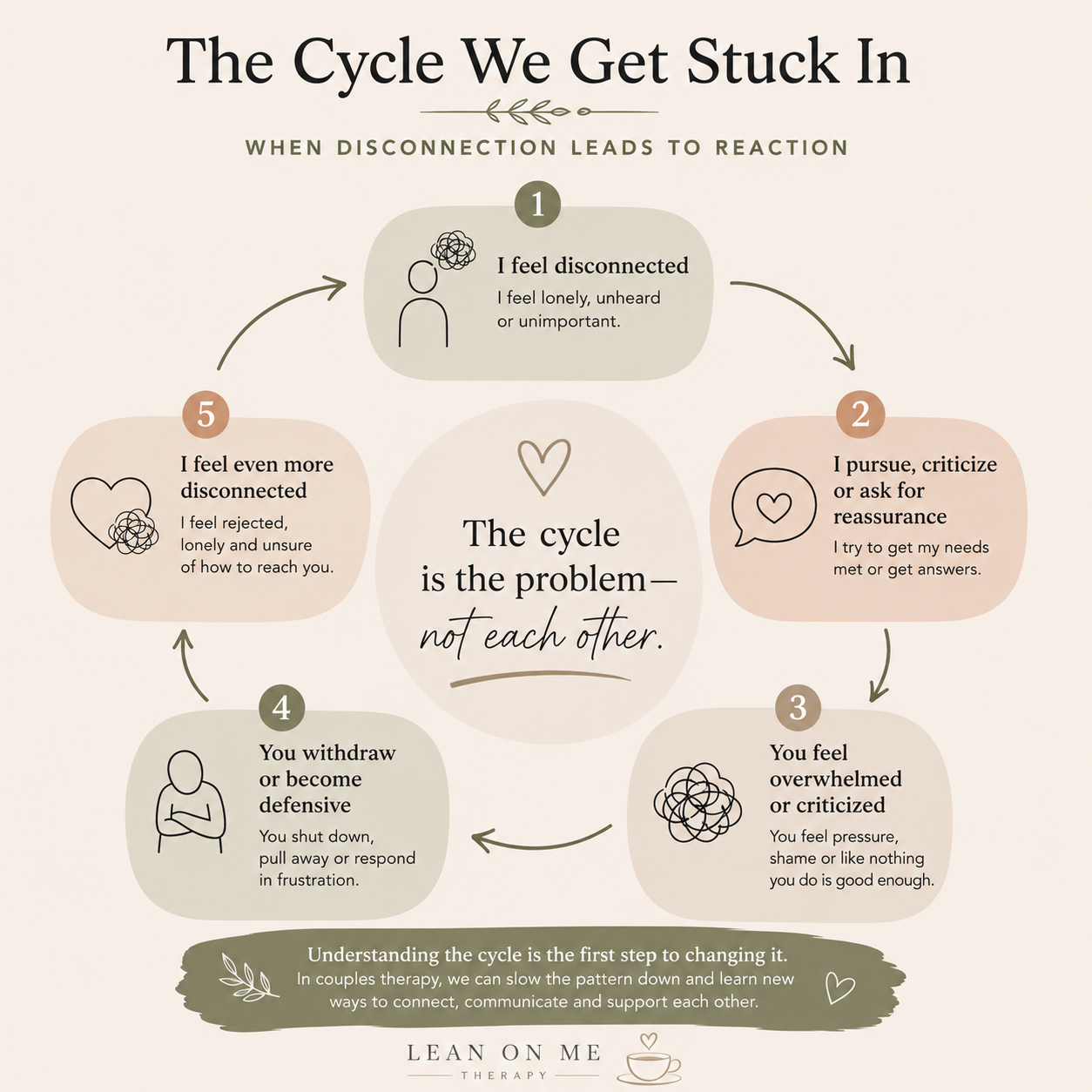
Couples therapy can help you recognize the cycle as the problem, rather than seeing each other as the problem.
What If Only One of Us Thinks There's a Problem?
It's common for partners to experience the same relationship very differently.
One person may feel deeply disconnected while the other thinks things are mostly okay.
That doesn't necessarily mean one person is right and the other is wrong.
You may simply have different needs, expectations or ways of experiencing connection.
The goal isn't to decide whose version of the relationship is correct.
It's to create space for both experiences to be understood.
Sometimes hearing your partner's experience in a different environment — without immediately needing to defend yourself or solve the problem — can change the conversation entirely.
Relationships Can Change During Major Life Transitions
Even strong relationships can feel different when life changes.
Moving. Changing careers. Getting married. Experiencing fertility challenges. Becoming pregnant. Having a baby. Parenting young children. Experiencing loss. Caring for aging parents.
Transitions can change roles, responsibilities, expectations and how much emotional energy each person has available.
Becoming parents can be an especially significant adjustment.
Suddenly, there may be interrupted sleep, less time together, changes in intimacy, new financial pressures and an enormous number of decisions to make.
There can also be a new mental load involved in remembering, organizing and anticipating everything a family needs.
You can love your partner and love the family you've created while still finding your relationship much harder than it used to be.
What Happens in Couples Therapy?
Couples therapy isn't about a therapist deciding who is right.
And it isn't about choosing sides.
Instead, therapy can provide a structured space to slow down conversations that may feel impossible to have at home.
Together, we might explore the patterns you get caught in, what happens when conflict begins, what each person needs but may have difficulty expressing, and how past experiences can influence the way you respond to each other now.
Depending on what brings you to therapy, we may also work on communication, rebuilding emotional connection, navigating resentment, strengthening trust, addressing intimacy concerns or adjusting to major changes in your relationship.
The goal isn't to create a relationship without disagreements.
Conflict is part of relationships.
The goal is to develop a different way of moving through those difficult moments together.
Do We Have to Be in Crisis to Start Couples Therapy?
No.
In fact, you may find it helpful to reach out before your relationship reaches a crisis point.
You don't have to wait until you're wondering whether the relationship can survive.
Couples therapy can also be preventative.
Maybe you've noticed you're becoming more disconnected.
Perhaps you're preparing for a major transition.
Maybe you're becoming parents and want to talk about expectations before the baby arrives.
Or perhaps things are generally okay, but there are a few conversations you never seem able to navigate well on your own.
Wanting to strengthen your relationship is enough of a reason to come to therapy.
Finding Your Way Back to Each Other
Relationships change.
The way you connected at the beginning of your relationship may not be what you need five, ten or twenty years later.
Life happens around you.
Responsibilities grow.
People change.
And sometimes couples lose sight of each other while trying to keep everything else going.
That doesn't necessarily mean the connection is gone.
Sometimes it means the relationship needs some attention.
Couples therapy isn't only about deciding whether to stay together. It can be a place to understand the patterns you've gotten stuck in and learn how to find your way back to each other.
At Lean On Me Therapy, I offer virtual couples therapy for couples across Ontario navigating communication difficulties, disconnection, resentment, relationship transitions and other challenges.
Therapy can provide a non-judgmental space where both partners have an opportunity to feel heard and better understand what is happening in the relationship.
If you're wondering whether couples therapy might be a good fit for your relationship, you're welcome to book a free 15-minute consultation.