

Having a baby can bring emotions you expected — love, joy, exhaustion, worry and overwhelm.
But it can also bring thoughts you weren't expecting at all.
You might suddenly imagine something bad happening to your baby. A frightening image may pop into your mind while you're carrying them down the stairs. You might find yourself repeatedly wondering, What if something happens while they're sleeping? or What if I somehow hurt my baby?
These thoughts can feel incredibly upsetting, especially when they seem completely at odds with how much you love and want to protect your baby.
Many parents experience unwanted or intrusive thoughts during the postpartum period. Having a thought does not automatically mean you want it to happen or that you will act on it.
Understanding what intrusive thoughts are — and when they may be a sign that you could use additional support — can make these experiences feel a little less frightening.
What Are Intrusive Thoughts?
Intrusive thoughts are unwanted thoughts, images, ideas or urges that seem to appear in your mind without you choosing them.
They can happen to anyone, but during the postpartum period they may become particularly focused on the baby's health, safety or well-being.
They might sound like:
What if I accidentally drop the baby?
What if something happens while they're sleeping?
What if I make a mistake and my baby gets hurt?
Sometimes they aren't even complete thoughts. They may be a sudden mental image or a flash of something frightening happening.
What often makes intrusive thoughts so distressing is that they feel completely inconsistent with what you actually want.
You may think, Why would my brain even come up with that?
And that question can quickly turn into another:
What does it say about me that I had that thought?
Why Can Intrusive Thoughts Happen After Having a Baby?
Becoming responsible for a tiny human can put your brain on high alert.
Suddenly there are countless things to think about — feeding, sleep, illness, falls, choking, car seats, development and whether you're doing everything "right."
Your brain may become especially focused on identifying possible threats.
Add interrupted sleep, hormonal changes, a major shift in identity, increased responsibility and the pressure many parents feel to keep their baby safe, and your nervous system may feel like it's constantly scanning for what could go wrong.
Sometimes an intrusive thought may essentially be the brain imagining the very thing you're desperately trying to prevent.
That doesn't make the thought any less upsetting, but it can help explain why frightening thoughts can appear even when they are the opposite of what you actually want.
When Intrusive Thoughts Become a Cycle
For some parents, the thought itself isn't the only difficult part.
It's what happens afterward.
A frightening thought appears, and you feel anxious. You start analyzing why you had it. You look for reassurance that it doesn't mean anything. You might check on your baby repeatedly, avoid certain situations or mentally review what happened.
You feel better for a little while.
Then another thought appears.
And the cycle begins again.
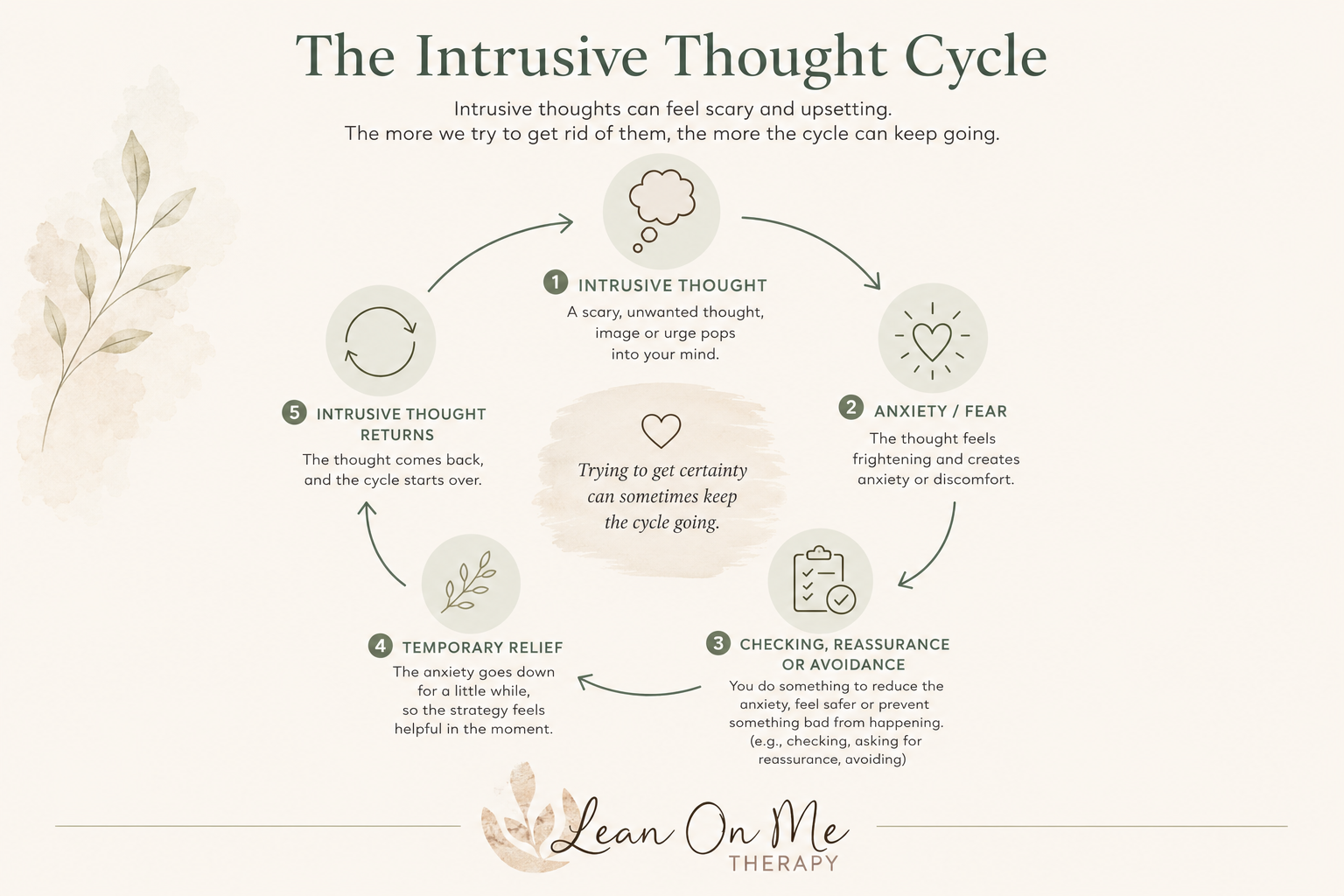
Over time, you may become increasingly focused on trying to prevent the thoughts from occurring at all.
Unfortunately, trying very hard not to think about something can sometimes make your brain pay even more attention to it.
Intrusive Thoughts and Postpartum Anxiety
Intrusive thoughts can sometimes occur alongside postpartum anxiety.
You may notice that your mind is constantly anticipating something going wrong or that you have difficulty relaxing even when your baby is safe.
You might repeatedly check whether your baby is breathing, spend significant amounts of time researching health concerns, seek reassurance from your partner or others, or struggle to let someone else care for your baby because it feels too risky.
If anxiety is becoming difficult to control or interfering with your ability to sleep, function or enjoy parts of your life, it may be worth reaching out for support.
This would be a great place to link to your Postpartum Anxiety vs. Normal New-Parent Worry article.
Intrusive Thoughts and Postpartum OCD
Intrusive thoughts can also be associated with obsessive-compulsive disorder (OCD), including OCD that develops or becomes more noticeable during pregnancy or postpartum.
With OCD, unwanted thoughts or images may become particularly persistent and distressing. A parent may also begin engaging in compulsions — behaviours or mental rituals intended to reduce anxiety or prevent something terrible from happening.
This could include repeated checking, seeking reassurance, avoiding certain situations, researching excessively or mentally reviewing events over and over.
The temporary relief these behaviours provide can unintentionally keep the cycle going.
If this sounds familiar, you don't need to determine on your own whether what you're experiencing is anxiety, OCD or something else. A qualified mental health professional can help you understand what's happening and what kind of support may be most appropriate.
Does Having an Intrusive Thought Mean I Want to Hurt My Baby?
This is often the question parents are most afraid to ask.
An unwanted, distressing intrusive thought is not the same thing as wanting or intending to act on that thought.
In fact, people experiencing intrusive thoughts are often deeply upset by them precisely because the thoughts conflict with their values and with how they feel about their baby.
However, it's important to distinguish unwanted intrusive thoughts from experiences where someone does feel they may act on thoughts of harming themselves, their baby or someone else, or is experiencing significant confusion, paranoia, unusual beliefs, hallucinations or a loss of connection with reality.
Those experiences require immediate assessment rather than waiting for a routine therapy appointment.
If you believe you or your baby may be in immediate danger, contact emergency services or go to your nearest emergency department.
Why Parents May Be Afraid to Talk About Intrusive Thoughts
One of the hardest parts of experiencing intrusive thoughts can be the fear of telling someone.
You may worry:
What will they think of me?
Will they think I'm a bad parent?
What if they misunderstand what I'm saying?
So instead, you keep the thoughts to yourself.
And when you're alone with them, they can start to feel even more powerful.
This is one reason it's so important for conversations about postpartum mental health to include experiences that aren't always easy to say out loud.
Parents deserve a space where they can talk openly about what's happening without immediately being met with judgment or shame.
What Can Help With Postpartum Intrusive Thoughts?
The right support depends on what you're experiencing and how much it's affecting your life.
For some parents, simply understanding what intrusive thoughts are can reduce some of the fear surrounding them.
It can also be helpful to notice what happens after the thought.
Are you spending a lot of time trying to figure out what it means? Checking something repeatedly? Asking someone to reassure you? Avoiding situations because you're afraid the thought might occur?
Therapy can help you better understand these patterns and develop different ways of responding to uncomfortable thoughts and uncertainty.
Approaches such as cognitive behavioural therapy (CBT) can be helpful for anxiety, while exposure and response prevention (ERP) is a well-established treatment for OCD.
Support may also include looking at the broader postpartum picture — sleep, overwhelm, relationships, identity changes, expectations, support systems and the enormous mental load that can accompany caring for a baby.
When Might It Be Time to Reach Out?
You don't need to wait until things feel unbearable before asking for support.
It may be helpful to speak with a mental health professional if intrusive thoughts are happening frequently, causing significant distress, leading to repeated checking or reassurance seeking, causing you to avoid caring for your baby in certain ways, interfering with sleep or daily life, or making it difficult to feel present with your baby or family.
Sometimes the most important first step is simply having somewhere safe to say:
I've been having thoughts that scare me.
You Don't Have to Keep Scary Thoughts to Yourself
The postpartum period can bring experiences that aren't always reflected in the version of new parenthood we see around us.
You can love your baby deeply and still experience anxiety.
You can be grateful and still feel overwhelmed.
And you can experience a frightening thought without that thought defining who you are as a parent.
If intrusive thoughts, anxiety or other postpartum experiences are making it difficult to feel like yourself, support is available.
At Lean On Me Therapy, I offer virtual Perinatal & Postpartum Therapy for individuals and couples across Ontario navigating pregnancy, postpartum and the transition into parenthood.
Therapy can provide a non-judgmental space to talk about the thoughts and feelings that may be difficult to say anywhere else.
If you'd like to explore whether therapy might be a good fit, you're welcome to book a free 15-minute consultation.