
Postpartum Rage: Why Am I So Angry After Having a Baby?

You expected to feel tired. You knew becoming a parent would be an adjustment.
But maybe you weren't expecting to feel this angry and irritable.
You might find yourself snapping at your partner over something small, feeling irritated by every sound or request, or going from relatively calm to completely overwhelmed in what feels like seconds.
And afterward, the guilt may set in.
Why am I so angry?
Why can't I handle this better?
I love my baby. Why do I feel like this?
If this sounds familiar, you may have come across the term postpartum rage.
While postpartum rage isn't a diagnosis on its own, intense anger and irritability can be part of the emotional experience after having a baby and may sometimes occur alongside postpartum anxiety, depression, or other perinatal mental health concerns.
What Does Postpartum Rage Feel Like?
Postpartum rage can look different from person to person.
For some parents, it feels like a constant underlying irritability. You may notice that things that normally wouldn't bother you suddenly feel unbearable.
For others, the anger comes in intense bursts.
You might experience:
Feeling unusually irritable or easily frustrated
Snapping or yelling more than you normally would
Feeling like you're constantly on edge
Becoming overwhelmed by noise, crying, touch, or repeated demands
Feeling resentful toward your partner
Having a very short fuse
Feeling physically tense or like anger is building inside you
Feeling out of control when you're angry
Feeling guilty or ashamed afterward
Wondering why you can't just enjoy this stage of your life
Sometimes the anger isn't even directed toward your baby. It may be directed toward your partner, family members, yourself, or simply the situation you're in.
But I Love My Baby. Why Am I So Angry?
Loving your baby and struggling with anger can exist at the same time.
Becoming a parent can involve an enormous amount of physical, emotional, and mental adjustment.
Your needs may suddenly come last. Your sleep may be interrupted. Your body may still be recovering. You may rarely have time alone, and someone may need something from you almost constantly.
At the same time, there can be tremendous pressure to feel grateful and enjoy every moment.
When your actual experience doesn't match what you thought parenthood would feel like, anger can become especially confusing.
Feeling angry doesn't mean you don't love your baby or aren't grateful to be a parent.
It may be a sign that something underneath the anger needs attention.
What Might Be Underneath Postpartum Anger?
One way of understanding anger is through the idea of an anger iceberg.
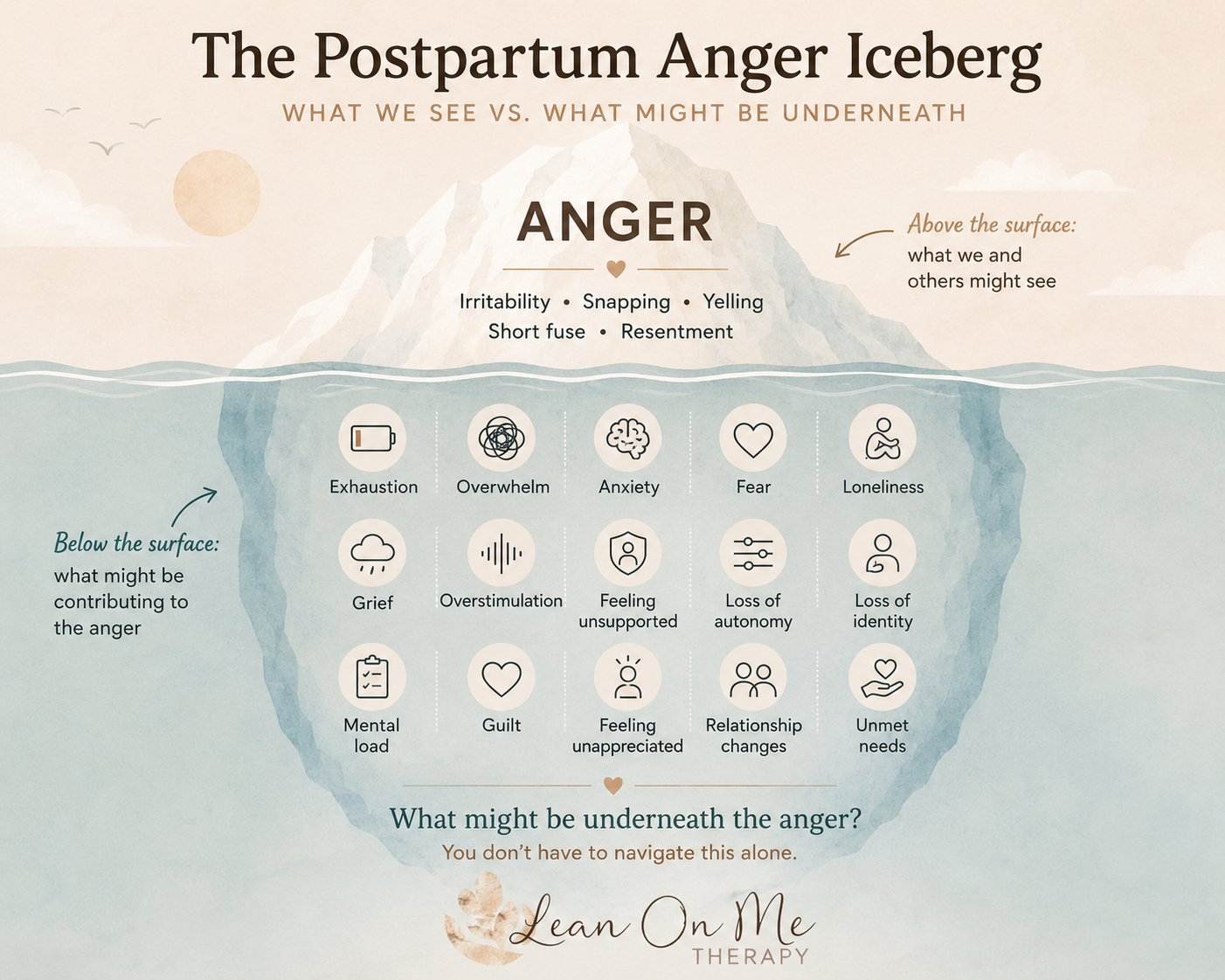
Like an iceberg, the part we can see above the surface may only tell us part of the story. Anger may be the emotion that feels most obvious — snapping at your partner, feeling irritated by your baby's crying, or noticing that your patience has become much shorter.
But underneath the surface, there may be other emotions, experiences, or unmet needs contributing to that anger.
For a parent in the postpartum period, underneath anger there might be:
Exhaustion.
You may be functioning on interrupted sleep while still trying to meet the needs of your baby, your family, and yourself.
Overwhelm.
There may be very little time when someone or something doesn't need your attention.
Anxiety or fear.
Constantly worrying about your baby, questioning your decisions, or feeling responsible for preventing anything from going wrong can keep your nervous system on high alert.
Overstimulation.
Crying, noise, feeding, being touched, carrying a baby, household responsibilities, and constant interruptions can leave you feeling overloaded.
Resentment.
You may feel as though you're carrying more of the parenting or household responsibilities, or that your partner's life has changed much less than yours.
Loneliness.
You can be surrounded by people — and even rarely be physically alone — while still feeling deeply alone in what you're experiencing.
Grief.
You may love your baby deeply while also grieving parts of your previous life, identity, freedom, relationship, or the way you imagined this stage would feel.
Feeling unsupported or unappreciated.
Sometimes anger shows up when you've been needing help, rest, reassurance, or recognition for a long time.
Thinking about anger this way doesn't mean that every angry reaction has a hidden explanation or that harmful behaviour is okay. Instead, it gives us another question to ask:
Rather than only asking, “How do I stop being so angry?” we can also ask, “What might be happening underneath my anger?”
Understanding what's below the surface can be an important first step toward figuring out what you actually need.
Postpartum Rage and Your Relationship
For many new parents, their partner becomes the person who receives the most frustration.
You may find yourself thinking:
Why do I have to ask you to do this?
How can you not see what needs to be done?
Why does your life seem so much less affected than mine?
Sometimes arguments that appear to be about bottles, dishes, bedtime, laundry, or whose turn it is to get up are really about something deeper.
You may be feeling alone, unappreciated, touched-out, overwhelmed, or resentful about how responsibilities are being shared.
The transition to parenthood can change the dynamics of a relationship significantly. Therapy can provide space to understand what's happening underneath the conflict and find ways to communicate needs before resentment continues to build.
What Can You Do When You Feel the Anger Building?
The goal isn't to never feel angry.
Anger is a normal human emotion. Instead, it can help to become more aware of what happens before you reach your breaking point.
You might start noticing:
When am I most likely to lose my patience?
What does anger feel like in my body before it becomes overwhelming?
Am I hungry, exhausted, overstimulated, anxious, or in need of a break?
Is there something I keep needing but haven't been able to ask for?
When possible, creating even a small amount of space between the feeling and your response can help.
That might mean putting your baby somewhere safe for a few minutes while you regulate yourself, stepping into another room, taking slow breaths, asking your partner to take over, going outside briefly, or reducing stimulation around you.
These strategies aren't about pretending everything is fine. They're about helping your nervous system come down enough that you can decide what you need next.
When Might It Be Time to Reach Out for Support?
You don't need to wait until anger feels completely out of control before talking to someone.
It may be helpful to reach out if:
Anger or irritability is happening frequently
Your reactions feel much more intense than they used to
You feel constantly overwhelmed or on edge
Anger is affecting your relationship
You're frequently yelling or reacting in ways that don't feel like you
You're experiencing significant anxiety, sadness, guilt, or hopelessness alongside the anger
You're struggling to enjoy things or feel connected to yourself
You're worried about how you're responding to your baby or the people around you
You simply don't want to keep feeling this way
If you ever feel that you may hurt yourself, your baby, or someone else, seek immediate support through emergency or crisis services rather than waiting for a therapy appointment.
How Can Therapy Help With Postpartum Anger?
Therapy isn't about being told that you need to calm down or become more patient.
Instead, we can become curious about what the anger is communicating.
Together, we might explore what tends to trigger it, what is happening underneath it, and what patterns may be keeping you feeling overwhelmed.
Therapy may involve working with anxiety, learning ways to regulate intense emotions, navigating changes in identity, communicating needs within your relationship, examining expectations around parenthood, and finding more realistic ways to care for yourself while caring for your family.
Sometimes simply having a space where you can say the things you've been afraid to say out loud can feel important too.
You Don't Have to Feel This Way Alone
The transition to parenthood can hold love and gratitude alongside exhaustion, resentment, grief, anxiety and anger.
Those experiences can coexist.
If anger or irritability during pregnancy or postpartum is becoming difficult to manage, support is available.
I offer virtual perinatal and postpartum therapy for individuals and couples across Ontario, including support for postpartum anxiety and depression, intrusive thoughts, postpartum anger and rage, birth trauma, pregnancy loss, fertility challenges, relationship changes and the transition to parenthood.
Learn more about Perinatal & Postpartum Therapy →
If you're wondering whether therapy might be right for you, you're also welcome to reach out for a free consultation.